
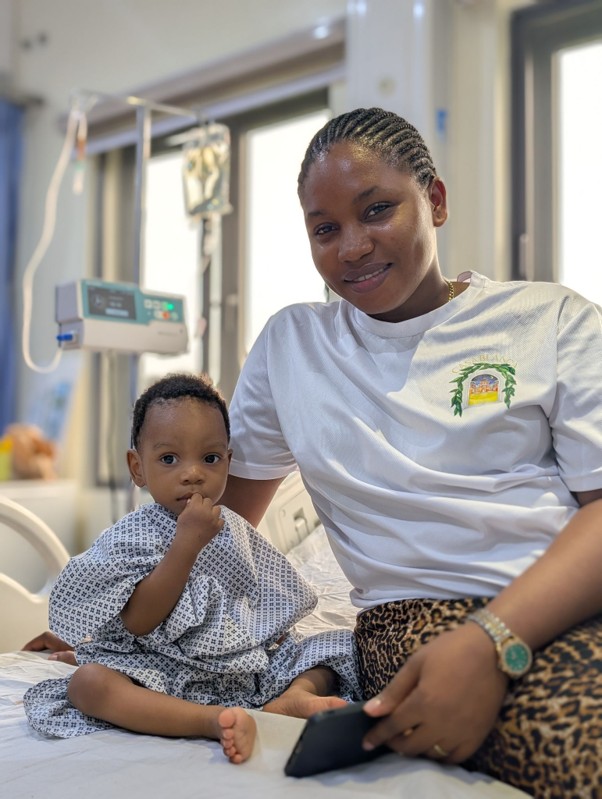
When Mrs. Onyedinma first noticed that her four-month-old daughter, Chimamanda, was breathing unusually fast, she did not think it was a sign of something serious.
Chimamanda was only 13 months old when her family learned that she had a ventricular septal defect (VSD) and patent ductus arteriosus (PDA), two conditions affecting the heart.
What began as a worrying symptom soon became a long and frightening journey.
Chimamanda was placed on medication, but her condition continued to worry her parents. Doctors eventually told them that she would need a procedure to close the openings in her heart.
For Mrs. Onyedinma, the uncertainty was overwhelming.
“It was frustrating and scary,” she says.
The moment that frightened her most came when Chimamanda became so unwell that she needed an oxygen mask.
That was the tipping point.
The hospital staff told her parents that they had brought her in just in time. Waiting any longer, they were told, could have made the situation much worse.
The doctors also explained that the defect in Chimamanda’s heart was unlikely to close on its own.
Mrs. Onyedinma knew they had to act.
She eventually brought Chimamanda to Dame Irene Okwuosa Memorial Hospital (DIOMH), where the family underwent further tests and assessments.
Then came another surprise.
The family had been preparing themselves for open-heart surgery. But after the tests at DIOMH, doctors determined that Chimamanda could instead be treated through an interventional cardiology procedure—a less invasive approach that did not require traditional open-heart surgery.
As a May 2026 beneficiary, Chimamanda received the care that gave her family renewed hope.
For a mother who had spent months frightened about what lay ahead, the news brought relief.
“I was nervous,” Mrs. Onyedinma says. “But when I saw the facility and met other parents who had gone through similar experiences, my faith was restored.”
Those encounters reminded her that her family was not alone.
Today, Mrs. Onyedinma looks back on the journey with gratitude—for the people who helped them, for the treatment Chimamanda received, and for the strength that carried them through the difficult months.
Her message to other parents is simple: don’t ignore the signs.
“Seek a second opinion and take action when you notice something is wrong,” she urges.
For Chimamanda, a frightening diagnosis has become a story of hope—and a reminder that finding the right care at the right time can change everything.